 Send Inquiry
 +817026632377
 English
 Spanish
 French
 German
 Italian
 Chinese (Simplified)
 Japanese
 Korean
 Arabic
 Portuguese


 Send Inquiry
SK95M (SK4) - UNS T72301 | High Carbon Tool Steel
MOQ : 100 Kilograms
SK95M (SK4) - UNS T72301 | High Carbon Tool Steel Specification
- Temper
- Annealed, Skin Passed, As Rolled (Hard), Q&T
- Width
- 3.0 to 300 Millimeter (mm)
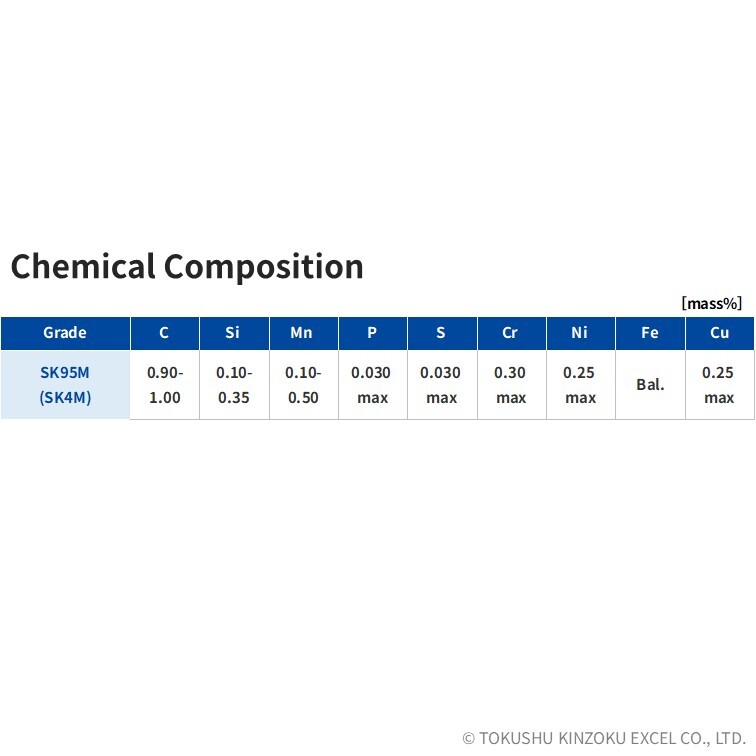
- Chemical Composition
- Refer to the image.
- Grade
- SK95M (SK4)
- Thickness
- 0.10 to 2.0 Millimeter (mm)
- Surface
- Bright, Dull
- Application
- Other
- Shape
- Coil, Sheet
SK95M (SK4) - UNS T72301 | High Carbon Tool Steel Trade Information
- Minimum Order Quantity
- 100 Kilograms
- Packaging Details
- Our Standard Packing for Export
SK95M (SK4) - UNS T72301 | High Carbon Tool Steel About
| Grade | SK95M (SK4) |
| Reference Standards (for reference only) | JIS SK95M (G3311)/SK95 (G4802) AISI/SAE W1-9 UNS T72301 |
| Shapes | Coil, Sheet |
| Thickness | 0.10 to 2.0mm (Strip, Sheet) |
| Width | 3.0 to 300mm (Strip, Sheet) |
| Length | Strip or Sheet (Length less than 2,000mm) |
| Technique | Cold Rolled |
| Temper | Annealed, Skin passed, As Rolled(Hard), Q&T |
| Surface Finish | Bright, Dull |
| Examples of Applications | Springs, Hinges, Bandsaws, Thomson Blades/Pinnacle Blades, Horns, Tape Measures, Metal Washers, Spacers |
| Coil I.D. | 300, 400, 500mm |
| Chemical Composition | Refer to the image |
| Mechanical Properties | Refer to the image |
| Density | 7.84 g/cm3 |
| Specific Heat | 490 J/(kg K) |
| Electrical Resistivity | 18 micro-ohm meter |
| Young's Modulus | 208 GPa |
| Thermal Expansion | 11.0 x 10⁻⁶/K (0-100oC) |
| Thermal Conductivity | 50.2 W/(m K) |
| Magnetism | Strong |
| Minimum Order Quantity | 100 Kilograms |
| Country of Origin | Japan, China, Taiwan |
| Payment Terms | Telegraphic Transfer (T/T) |
| Delivery Terms | EXW, FOB, CIF, DAP etc. |
| Packing | Our Standard Packing for Export |
| Export Markets | Asia, Middle East, North America, South America, Europe etc. |
SK95M (SK4) Description :
SK95 (former JIS grade symbol: SK4) is a High Carbon steel with a Carbon content of about 0.95%.
Carbon tool steel is the most widely used cold rolled carbon steel because of its good balance of workability, hardenability, product performance, and price. SK95 has a higher Carbon content and higher hardenability than SK85, so it is often used for higher grade applications.
Most SK materials are generally heat treated before or after processing.
Our materials are maintained to have optimum surface roughness after heat treatment, which allows us to achieve an ideal product finish after blackeing.
Applications That Demand Precision
This tool steel is primarily chosen for parts subjected to repetitive stress or wear, including springs, bandsaws, blades, and spacers. These applications benefit from the steel's inherent strength and wear resistance, which extend service life and ensure consistent performance. Industries ranging from manufacturing and construction to specialized equipment trust SK95M (SK4) for mission-critical tasks.
FAQ's of SK95M (SK4) - UNS T72301 | High Carbon Tool Steel:
Q: How is SK95M (SK4) tool steel typically processed for industrial use?
A:SK95M (SK4) is processed through methods such as annealing, skin passing, rolling, and quenching and tempering. These treatments adjust the hardness and ductility to suit various end-use requirements, ensuring the steel meets specific application needs.Q: What are the common applications of SK95M (SK4) high carbon tool steel?
A:This steel is widely used to manufacture springs, hinges, bandsaw blades, measuring tapes, metal washers, spacers, and specialty blades. Its high hardness and edge retention properties make it suitable for demanding mechanical parts.Q: When should I choose the annealed versus hard-rolled or Q&T temper for SK95M (SK4)?
A:Annealed SK95M (SK4) is best for forming and machining operations, while hard-rolled and quenched & tempered (Q&T) options are preferred when maximum hardness and strength are required for finished parts.Q: Where is SK95M (SK4) tool steel commonly supplied from?
A:SK95M (SK4) tool steel is primarily exported, manufactured, and supplied by reputable companies in Japan, recognized for their quality control and advanced steelmaking techniques.Q: What is the benefit of using SK95M (SK4) steel in springs and blades?
A:The chief advantage is its high wear resistance and ability to retain hardness under stress, resulting in longer component life, reduced maintenance, and reliable performance even in repetitive or heavy-duty applications.Q: How do I determine the correct width and thickness for my application?
A:Selection depends on design requirements-SK95M (SK4) is available in widths of 3.0-300 mm and thicknesses of 0.10-2.0 mm, allowing customization for both intricate and robust components. Consulting technical drawings or standards ensures optimal choice.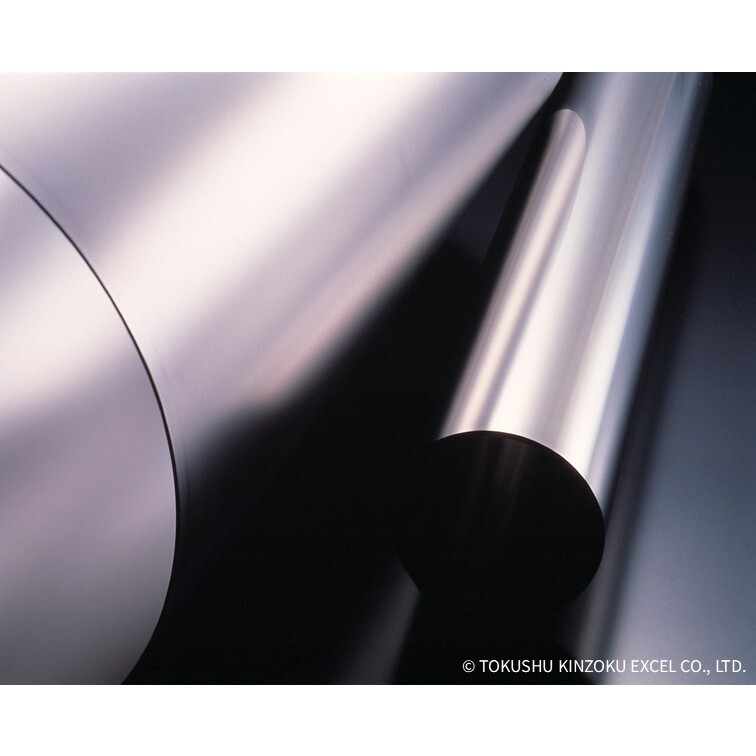
Tell us about your requirement

Price:
Quantity
Select Unit
- 50
- 100
- 200
- 250
- 500
- 1000+
Additional detail
Mobile number
Email

More Products in Carbon Tool Steels / Steels for Knitting Needles Category
M2 | Steel for Knitting Needles Textile Machinery
Minimum Order Quantity : 100 Kilograms
Width : 3.0 to 300 Millimeter (mm)
Surface : Bright, Dull
Application : Other, Knitting Needles, Knitting Related Parts, Textile Machinery Parts
Temper : Annealed, Skin Passed, As Rolled (Hard)
Shape : Coil, Sheet
MB-1 | Steel for Knitting Needles and High Cleaness Steel
Minimum Order Quantity : 100 Kilograms
Width : 3.0 to 300 Millimeter (mm)
Surface : Bright, Dull
Application : Other
Temper : Annealed, Skin Passed, As Rolled (Hard), Q&T
Shape : Coil, Sheet
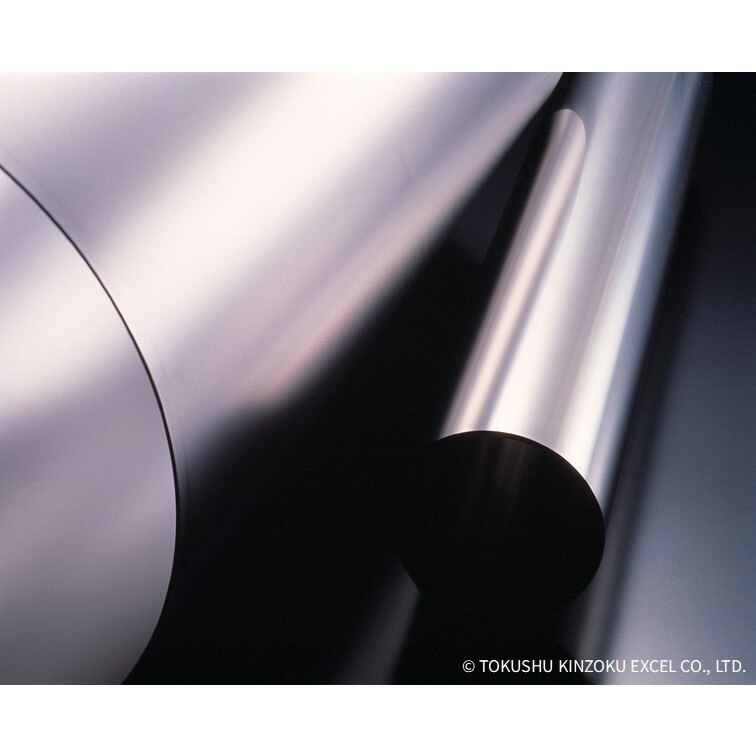
M1 | Steel for Knitting Needles Textile Machinery
Minimum Order Quantity : 100 Kilograms
Width : 3.0 to 300 Millimeter (mm)
Surface : Bright, Dull
Application : Other
Temper : Annealed, Skin Passed, As Rolled (Hard)
Shape : Coil, Sheet
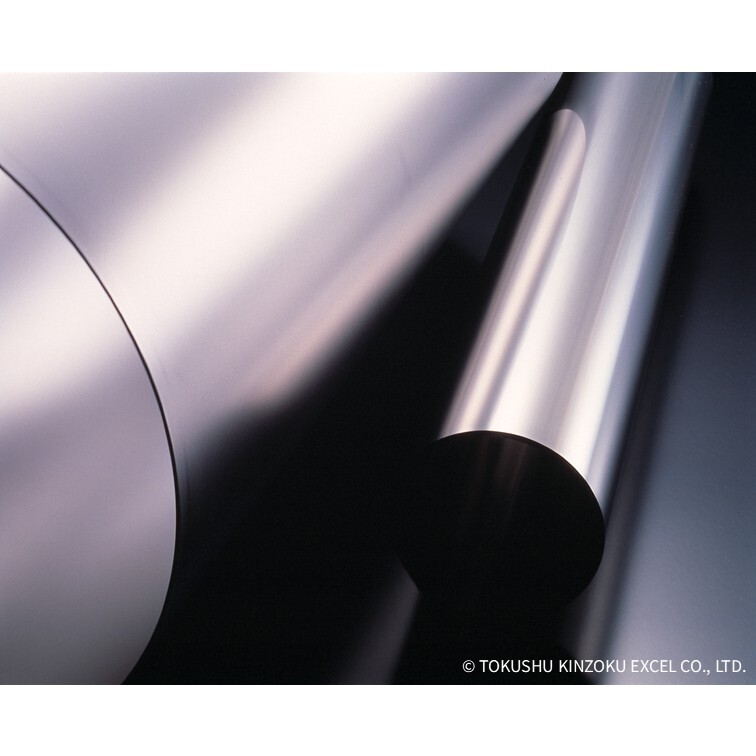
SK85M (SK5) - UNS T72301 | High Carbon Tool Steel
Minimum Order Quantity : 100 Kilograms
Width : 3.0 to 300 Millimeter (mm)
Surface : Bright, Dull
Application : Other
Temper : Annealed, Skin Passed, As Rolled (Hard), Q&T
Shape : Coil, Sheet

TOKUSHU KINZOKU EXCEL CO., LTD.
Contact Details
- 6F Mejiro Hakubutsukan Bldg., 1-4-25 Mejiro, Toshima-ku,Tokyo - 1710031, Japan
- Phone : +81-3-69129232
- Mr Takao Sueyoshi (Manager)
- Mobile : +817026632377, +817014150872
- Send Inquiry

 Send Inquiry
 |
TOKUSHU KINZOKU EXCEL CO., LTD.
All Rights Reserved.(Terms of Use) Developed and Managed by Infocom Network Private Limited. |
